Mitigate Risk, Lead with Clarity |
|
|---|
|
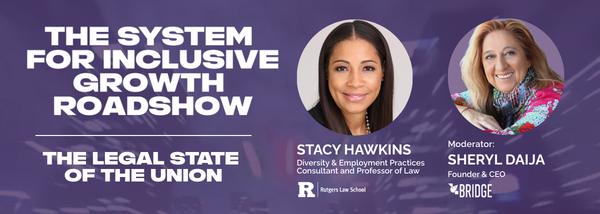
On Thursday morning, BRIDGE convened leaders at Index Exchange for our first System for Inclusive Growth (SIG) Roadshow. The political landscape is shifting fast and with it, the legal, reputational, and operational risks.
This special issue recaps the first session which was a fireside chat on the Legal State of the Union between BRIDGE founder and CEO Sheryl Daija, and legal expert Stacy Hawkins, Professor of Law at Rutgers University.
|
|
|
|---|
|
1. Nine Months In: What’s Changed the Most? |
| | | | | | QUESTION: We have been doing BRIDGE FORWARD now for over 50 weeks, what has been the most significant change you have seen? "We’ve witnessed an unprecedented weaponization of civil rights enforcement mechanisms." –Stacy Hawkins
The most significant shift is in the enforcement landscape and in the sophistication of the strategy. We are witnessing an unprecedented use of civil rights enforcement mechanisms to advance political objectives.
The EEOC and DOJ are no longer operating as neutral investigatory bodies responding to complaints. We have seen investigative letters sent to law firms without complainants. We have seen threats to deploy the False Claims Act against federal contractors accused of “misrepresenting” DEI compliance. We have seen the FTC pursue antitrust theories against law firms for signing longstanding diversity statements.
The Columbia University settlement of $225 million over antisemitism allegations, with no individual complainants receiving damages, reflects a departure from traditional civil rights enforcement norms.
What has not changed is the law itself.
Courts continue to dismiss litigation that lacks injured parties. Lower federal courts have enjoined multiple administration actions on procedural and constitutional grounds. The statutory and constitutional foundations remain intact even as enforcement posture intensifies.
STRATEGIC IMPLICATION This is a moment that requires discernment. The volume of enforcement activity has increased, but the governing legal standards remain stable. Institutions that ground their decisions in statute and precedent, rather than rhetoric or pressure, will be better positioned to navigate volatility without overcorrecting. | | | | | |
2. Legal Obligation vs. Agency Posture vs. Political Signaling |
| | | | | | QUESTION: How should companies distinguish between legal obligation, agency posture, and political signaling when making decisions right now?
“The law is the law.” –Stacy Hawkins
This distinction may be the most important one for leaders to internalize.
Legal obligation is defined by statute and binding court precedent. That includes Title VII of the Civil Rights Act of 1964, Supreme Court rulings, and established federal case law. These are enforceable standards.
Agency posture reflects how administrative bodies such as the EEOC and DOJ choose to interpret and prioritize enforcement. That posture can shift from one administration to another. It does not alter the underlying statutory requirements. Political signaling is rhetoric or policy framing intended to influence behavior without changing the law itself. It often creates pressure to overcorrect in anticipation of enforcement that may not be legally grounded.
The U.S. District Court for the District of Maryland reinforced this principle when it struck down enforcement of the Department of Education’s DEI guidance, stating that agencies cannot enforce the law contrary to what the law says or what courts have determined it means.
At the same time, we have seen institutions enter settlement agreements committing to comply with an administration’s interpretation of civil rights law. That is not the same as complying with the law itself.
Understanding this hierarchy is critical. Statute and precedent control. Agency posture may shape risk exposure. Political signaling may shape perception. They are not interchangeable.
STRATEGIC IMPLICATION
Decision-making frameworks must separate legal requirements from enforcement trends and from political messaging. When those categories blur, organizations risk surrendering durable legal ground in response to temporary posture.
Clarity at the board and executive level is essential to prevent over-compliance that exceeds what the law actually requires. | | | | | |
3. The EEOC’s Transformation and What The Starbucks Case Tells Us |
| | | | | | QUESTION: In light of the recent actions the EEOC has taken against Nike as well as a Feb. 2026 federal judge’s ruling in favor of Starbuck’s DEI policies, what guidance should we be giving employers?
“Prior administrations—across both parties—have affirmed that DEI is not only compatible with Title VII, but often in furtherance of it.” –Stacy Hawkins
Recent actions by the Equal Employment Opportunity Commission represent a notable shift in enforcement posture. The agency has solicited “reverse discrimination” complaints, initiated investigations without identified charging parties, and sent inquiry letters to employers and law firms absent individual complainants.
The investigation into Nike reflects this approach. So do similar letters sent to law firms requesting information without an underlying complaint.
At the same time, the federal court ruling involving Starbucks is instructive. The Missouri Attorney General filed suit alleging that Starbucks’ diversity initiatives constituted unlawful discrimination. The court dismissed the case because there was no individual plaintiff who claimed to have suffered harm.
This procedural threshold matters. Under Title VII of the Civil Rights Act of 1964, a claimant must demonstrate that they were an employee or applicant who experienced discrimination. Disagreement with an employer’s diversity program is not sufficient to establish standing.
Even as enforcement posture becomes more aggressive, courts continue to require concrete evidence of injury tied to statutory violations. That requirement remains a meaningful guardrail.
STRATEGIC IMPLICATION Employers should anticipate continued investigative activity and public scrutiny. Exposure should be assessed against statutory standards, procedural requirements, and documented employment practices. Courts remain focused on evidence, standing, and actual harm.
Organizations that structure diversity efforts around open access, nondiscrimination in employment decisions, and clear business justification are operating within established legal parameters, regardless of current political rhetoric. | | | | | |
4. EEO Leaders, Disparate Impact, and Harassment: The Risk That Remains |
| | | | | | QUESTION: A group of former EEOC Commissioners have convened a new organization called EEO Leaders to uphold previous standards. What are the potential risks for employers around both the current uncertainty surrounding EEOC positions?
“Disparate impact was codified into Title VII by Congress in 1991. If a charging party brings that complaint to the EEOC, they have an obligation to investigate and resolve it.” –Stacy Hawkins
The formation of EEO Leaders reflects concern about the current direction of enforcement priorities. Two areas require particular attention: disparate impact and harassment.
The current EEOC has stated it will not pursue disparate impact claims. That is a policy decision. It does not change the statute.
Congress amended Title VII in 1991 to codify disparate impact as a theory of liability. Neutral employment practices that disproportionately exclude protected groups may create legal exposure unless the employer can demonstrate business necessity and the absence of a less discriminatory alternative.
Even if the EEOC declines to bring such claims, private plaintiffs and class action attorneys may still do so. A shift in agency posture does not eliminate litigation risk. If representation declines sharply, if promotion rates skew heavily toward one demographic group, or if pay equity gaps widen, those patterns may support a disparate impact claim. The absence of agency enforcement does not insulate employers from private action.
Harassment presents a similar dynamic. The EEOC rescinded guidance issued during the prior administration that addressed discrimination based on sexual orientation and gender identity. However, the underlying law has not changed.
The Supreme Court has long recognized harassment as a form of sex discrimination. In 2020, the Court confirmed that sex discrimination includes sexual orientation and gender identity. Rescinding guidance does not rescind precedent.
STRATEGIC IMPLICATION
Employers should not interpret reduced federal enforcement as reduced legal obligation. Disparate impact liability remains codified in federal law. Harassment protections remain grounded in Supreme Court precedent.
Organizations that step back from monitoring workforce data, maintaining complaint mechanisms, or conducting harassment prevention training increase exposure to private litigation. Stability in internal compliance systems is especially important during periods of external enforcement volatility. | | | | | |
5. Title VII: The Foundation That Holds |
| | | | | | QUESTION: As you and I both noted, despite it being misinterpreted, Title VII remains the law of the land. What does this mean for employers?
“In fact, even in Students for Fair Admissions, the Supreme Court stated: The pursuit of diversity is a commendable and worthy goal. They didn’t ban diversity. They banned one specific mechanism.” –Stacy Hawkins
Title VII prohibits employment discrimination based on race, color, religion, sex, and national origin. Over time, the Supreme Court has clarified that this includes harassment as a form of discrimination, sexual orientation and gender identity as forms of sex discrimination, and disparate impact as a theory of liability even where policies are facially neutral.
None of those interpretations have been reversed.
Congress has not amended Title VII. The Supreme Court has not overturned its prior employment precedents. While the 2023 Students for Fair Admissions decision addressed race-based admissions in higher education, employment law has long prohibited race-based hiring and promotion decisions.
What has shifted is the narrative.
There is a growing claim that DEI as a broad category is inherently unlawful. That assertion is not supported by the statute. Courts reviewing employment cases continue to focus on whether specific practices involve impermissible decision-making based on protected characteristics, not on whether an organization maintains diversity initiatives, affinity groups, targeted outreach, or inclusive culture programs.
Even in Students for Fair Admissions, the Court acknowledged that the pursuit of diversity is a commendable goal. The ruling addressed a specific mechanism, not the broader objective.
The legal standard remains clear. Employers may not make employment decisions based on race, ethnicity, or sex. At the same time, employers may recruit broadly, remove systemic barriers, monitor representation data, promote inclusive culture, and expand opportunity so long as employment decisions themselves remain nondiscriminatory.
STRATEGIC IMPLICATION
Employers should anchor policy decisions in statutory requirements and binding precedent rather than in shifting political rhetoric. Title VII continues to prohibit discriminatory employment decisions while permitting inclusive practices that expand access and address structural barriers.
Organizations that conflate lawful inclusion efforts with prohibited discrimination risk retreating from practices that both strengthen performance and reduce legal exposure. | | | | | |
6. Constitutional Limits on Funding Conditions |
| | | | | | QUESTION: Executive orders and funding conditions are often used as leverage—especially in higher education, research, and contracting. Where are the real limits on the government’s ability to condition funding on ideology or internal governance choices?
“Lower federal courts are affirming both procedural and constitutional limits on executive authority.” –Stacy Hawkins
While the federal government has broad authority under the Spending Clause to attach conditions to funding, that authority is not unlimited.
The Supreme Court has long held that funding conditions must be clearly stated, related to the federal interest in the program, and not so coercive that they effectively compel compliance. The government cannot use funding as a tool to force recipients to surrender constitutional protections or adopt ideological positions that Congress could not directly mandate.
We are seeing those boundaries tested.
Conditions requiring diversity-related certifications from contractors, threats to withhold research funding from universities with certain inclusion programs, and attempts to tie grants to governance changes raise constitutional and administrative law questions.
Courts have already enjoined several executive actions on procedural or constitutional grounds. These decisions signal that the judiciary is prepared to review whether funding conditions exceed statutory authority or violate constitutional limits.
The use of the False Claims Act to pursue contractors based on alleged “misrepresentation” of compliance with an administration’s interpretation of civil rights law presents similar issues. The statute requires a knowing false statement about a material fact. Agreement with a political interpretation of the law is not, in most cases, a contractual term.
The legal framework remains structured around limits on executive overreach, even where enforcement tactics have become more aggressive.
STRATEGIC IMPLICATION
Organizations receiving federal funds should assess funding conditions carefully rather than assuming all directives are automatically enforceable. The relevant questions are legal ones: Is the condition grounded in statute? Is it clearly stated in the contract? Is it related to the purpose of the funding? Does it implicate constitutional protections?
Periods of enforcement expansion often generate litigation that clarifies those limits. Institutions that evaluate funding requirements through that lens are better positioned to distinguish between lawful conditions and those subject to challenge. | | | | | |
7. Navigating Federal Rollbacks vs. State Protections |
| | | | | | QUESTION: There’s growing tension between federal rollbacks and state-level protections, particularly around employment, education, and LGBTQ+ rights. How should organizations think about compliance when operating across various jurisdictions?
“This is one where you just have to work closely with legal counsel. In some instances, federal law is going to preempt state law. However, state law can actually provide more protection than federal law.” –Stacy Hawkins
The constitutional principle of preemption establishes that federal law controls when it directly conflicts with state law and is enacted within federal authority. That principle does not mean that federal law eliminates all state protections.
Federal law generally sets a floor, not a ceiling. States may provide broader civil rights protections than federal law requires. They may not provide less protection where federal constitutional or statutory guarantees apply.
In the employment context, many states recognize protected categories or remedies that go beyond federal law. Before the Supreme Court clarified that sex discrimination includes sexual orientation and gender identity, several states had already incorporated those protections into their own civil rights statutes. Those provisions remain in force.
This creates complexity for organizations operating nationally. A policy that complies with federal enforcement posture may still create exposure under state law. In some instances, religious accommodation claims recognized under federal law may conflict with state-level protections for LGBTQ+ employees. Courts are continuing to refine how those tensions are resolved.
The result is not a single compliance standard, but a layered one.
STRATEGIC IMPLICATION
Multi-state employers should map their obligations by jurisdiction rather than relying on a single federal baseline. Where state law provides greater protection and does not directly conflict with federal statute, organizations may follow the more protective standard.
Consistency remains important, but consistency must be grounded in legal analysis rather than assumption. During periods of divergence between federal and state enforcement, careful documentation of compliance rationale becomes increasingly important. | | | | | |
8. What Legally Durable Inclusion Looks Like Right Now |
| | | | | | QUESTION: For leaders who want to “hold steady” rather than overcorrect, what does legally durable inclusion look like right now?
“Diversity is not illegal. Do not overcomply with the law. The best defense as a matter of law to your diversity practices is a business defense.” –Stacy Hawkins
Legally durable inclusion begins with clarity about what has always carried legal risk and what has not.
Practices that involve race- or gender-based decision-making in hiring, promotion, or compensation have long presented exposure under Title VII. Using protected characteristics as a tiebreaker or structuring compensation in ways that hinge directly on demographic outcomes requires careful scrutiny and, in many cases, redesign.
By contrast, targeted recruiting, inclusive outreach, affinity groups open to all employees, supplier diversity initiatives, bias awareness training, and efforts to remove structural barriers have consistently been upheld when implemented in nondiscriminatory ways.
The distinction is between decision-making and opportunity creation. Employers may not choose one candidate over another because of race or sex. Employers may broaden recruitment channels, evaluate job criteria for unintended barriers, and build inclusive workplace systems that expand access.
Durability also depends on process. Programs structured around fairness, transparency, and consistent application are more defensible than those framed around guaranteed outcomes.
Data remains important. Monitoring representation, advancement patterns, pay equity, and inclusion indicators allows organizations to identify risk early and to demonstrate that practices are grounded in legitimate business objectives rather than demographic preference.
The strongest defense is alignment between inclusion efforts and business performance. When diversity initiatives are clearly tied to innovation, market growth, workforce stability, and risk management, they are evaluated as governance strategy rather than ideology.
STRATEGIC IMPLICATION
Holding steady does not mean maintaining every program unchanged. It means evaluating initiatives against statutory requirements, restructuring where necessary, and preserving those that are legally sound and operationally effective.
Organizations that distinguish between high-risk practices and durable inclusion infrastructure are better positioned to sustain competitive advantage while remaining within established legal boundaries. | | | | | |
BRIDGE POV: The Law Is Your Anchor |
| | | | | | Institutional autonomy is now the first line of defense.
The law has not been rewritten. Title VII remains intact. Constitutional limits on executive authority remain intact. Courts continue to require evidence, standing, and statutory grounding.
What has shifted is posture.
When enforcement agencies narrow their role or reinterpret their mandate, responsibility does not disappear. It migrates.
If the EEOC declines to pursue disparate impact claims, disparate impact remains codified in statute. If harassment guidance is rescinded, Supreme Court precedent still governs. If enforcement becomes selective, private litigation risk does not recede.
In this environment, the responsibility of companies becomes larger, not smaller.
Organizations cannot interpret reduced federal enforcement as reduced obligation. The absence of guidance does not eliminate the duty to prevent discrimination, monitor workforce impact, or protect employees from harassment.
Institutional autonomy is about stewardship. It is the ability to evaluate funding conditions, investigative letters, and public pressure against actual legal standards. It is the discipline to hold steady when rhetoric accelerates but statute does not.
Periods of volatility reward clarity. The leaders who will navigate this moment successfully are those who understand the hierarchy: statute governs, courts interpret, agencies posture.
Compliance remains essential. But compliance must be anchored in law, not fear. | | | | | |
| | | | | | 1. Separate Law from Posture: Establish a formal review process that distinguishes statutory obligations from agency enforcement trends and political messaging. Ensure that board and executive leadership understand what is legally required versus what is rhetorically amplified. Overcorrection creates risk. So does complacency. Clarity must drive decision-making.
2. Preserve Core Compliance Infrastructure: Do not scale back harassment prevention, disparate impact monitoring, or workforce data analysis in response to shifting federal posture. Reduced enforcement does not reduce exposure. Private litigation, state protections, and reputational risk remain active. Internal systems must remain stable even when external guidance changes.
3. Design for Durability: Audit diversity-related initiatives through a defensibility lens. Eliminate or restructure practices that involve protected-characteristic decision-making. Preserve and strengthen access-oriented, inclusive, and business-aligned programs. Durable inclusion is structured, transparent, and tied to enterprise value. | | | | | |
|
|---|
COMMUNITY EVENTS | The conversation continues and expands at our annual retreat, BRIDGE26: Beyond the Line, taking place May 3–5 in Newport Beach.
With an NPS above 90 for three consecutive years, BRIDGE26 is where leaders come together to sharpen how they think, how they decide, and how they build growth capabilities that endure. | | |
|
|
|---|
ABOUT PROJECT FORWARD | | | | | | | Led by BRIDGE, Project FORWARD is a weekly leadership briefing that distills the most consequential legal, political, and reputational developments shaping DEI and inclusive growth. Each issue provides legal interpretation, BRIDGE’s point of view, and actionable strategies to help leaders safeguard trust, anticipate risk and make credible value-based decisions in a volatile environment.
Who it’s for: CMOs, CCOs, Chief DEI Officers, GCs, Heads of Risk, CHROs, and senior leaders across DEI, marketing, brand, policy, and legal functions. FOR PAST ISSUES OF PROJECT FORWARD WEEKLY GUIDANCE PLEASE VISIT HERE. *These Project FORWARD updates should not be construed as legal advice or counsel. They are for educational and instructive purposes only, to aid our understanding about how best to actively continue our mission in response to this moment. | | | | | |
|
|
|
|---|
 | |
|  | |
| |
|---|
|
|
|
|
|
|
|---|
|
| | 1276 Auto Park Way Suite D, PMB 183, Escondido, CA 92029 |
| This email was sent to {{ contact.EMAIL }} |
| You've received it because you've subscribed to our newsletter. |
| | |
|
|
|---|
|
|
|