| | WEEKLY ISSUE 63 | May 8, 2026 |
|
|
|
|---|
|
| | SPECIAL ISSUE
RECAP FROM BRIDGE26 |
|
|---|
|
Mitigate Risk. Lead with Clarity. |
|
|---|
|
This special issue recaps a high-impact BRIDGE26 session convening leading legal and policy experts to assess where the law stands, where it is being tested, and what employers must do to lead with both clarity and resolve. |
|
|
|---|
|
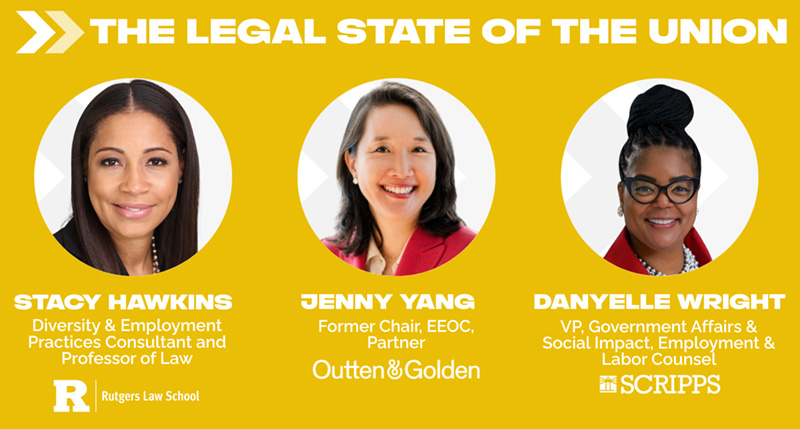
SESSION OVERVIEW: The Legal State of the Union | This session brought together three experts navigating the intersection of law, policy, and corporate practice in real time. Stacy Hawkins, Diversity and Employment Practices Consultant and Professor of Law at Rutgers University, provided an authoritative assessment of the rapidly shifting legal and regulatory landscape. Jenny Yang, Partner at Outten & Golden LLP and former Chair of the U.S. Equal Employment Opportunity Commission, offered a deep institutional perspective on how current enforcement priorities diverge from longstanding civil rights frameworks. Danyelle Wright, VP of Government Affairs and Social Impact and Employment and Labor Counsel at The E.W. Scripps Company, moderated the discussion and grounded the conversation in the operational realities facing corporate leaders.
The conversation examined the accelerating cycle of executive orders, investigations, litigation, settlements, and corporate response, while separating legal reality from political pressure and public perception. Central themes included the continued strength of Title VII protections, the growing focus on disparate impact doctrine, the distinction between legal, regulatory, and reputational risk, and the danger of fear-driven overcorrection.
What follows is a focused briefing on what has changed, what has not, and what leaders need to understand now as they navigate this evolving environment. |
|
|
|---|
|
1. What Is the Lay of the Land Since the Initial 2025 Executive Orders? |
| | | | | |
“What we are involved in now can best be described as an action reaction loop.” – Stacy Hawkins
The dominant pattern of the past year is best understood as an action-reaction loop. Professor Stacy Hawkins described a high-volume enforcement strategy in which the administration initiates investigations across a range of corporate, institutional, and professional targets, then uses the threat of prolonged legal action to drive quick settlements. She pointed to early settlements involving law firms, universities such as Columbia and Penn, and IBM’s $17 million False Claims Act settlement as examples of this approach.
At the same time, Hawkins emphasized that not all targets have yielded. Nike, also under EEOC investigation, has publicly stated that it believes it has done nothing wrong and is cooperating with the process. Hawkins also referenced the EEOC’s investigation into The New York Times and noted the company’s public position that it intends to defend its practices rather than settle.
Hawkins further observed a pattern in the administration’s targets: highly visible institutions and perceived political opponents. Despite the volume of enforcement activity and settlements, she stressed that organizations challenging these actions in court have often succeeded, with several enforcement actions blocked or enjoined.
She also noted that the DOJ initially carried much of the enforcement activity while the EEOC lacked a quorum. Now that the EEOC is operational again, activity has accelerated, particularly around workplace diversity efforts, foreign worker hiring and visa programs, and religious discrimination issues connected to LGBTQ+ workplace protections.
Strategic Implication
The current enforcement environment is designed to create uncertainty, accelerate reputational pressure, and encourage preemptive retreat before legal claims are fully tested. Distinguishing between the threat of enforcement and actual legal exposure remains critical in assessing risk, response, and long-term strategy. | | | | | |
2. What Is the Difference Between Business Risk and Legal Risk? |
| | | | | | “The law hasn't changed, but the enforcement posture has departed significantly from the law.” – Jenny Yang
The distinction between legal risk and business risk was raised, noting that many organizations are attempting to reduce the possibility of enforcement activity to zero, even when the actual legal exposure may be limited.
Stacy Hawkins emphasized that the underlying law governing employment discrimination has not fundamentally changed. Instead, what has changed is the enforcement posture of the agencies administering it. She noted that when many of these matters have proceeded to court, employers and institutions have often prevailed, with courts rejecting efforts that overstate the scope of the law.
Hawkins pointed to IBM’s $17 million False Claims Act settlement as an example of a business decision rather than a legal concession, noting that the company admitted no legal liability. For some organizations, the cost of prolonged conflict with the federal government, or the strategic risk to pending transactions or other business priorities, may outweigh the benefit of mounting a legal defense, even when that defense may ultimately succeed.
Jenny Yang further distinguished legal risk from regulatory risk, describing the current gap between the two as the most significant she has seen in her career. While the law itself remains intact, enforcement agencies are pursuing priorities and interpretations that depart substantially from longstanding enforcement norms.
Both Hawkins and Yang stressed that many issues currently being framed as “legal risk” are, in practice, business judgments about reputation, operational priorities, and tolerance for conflict with the administration. Yang also emphasized that the framing of the question itself matters. Asking how to continue a commitment to inclusion produces a very different analysis than asking how to reduce all risk to zero.
Strategic Implication The current environment requires a clear distinction between legal exposure, regulatory pressure, and business decision-making. Allowing enforcement activity or political pressure to substitute for actual legal analysis increases the risk of unnecessary overcorrection. | | | | | |
3. How Is the Federal Government Departing from Established Civil Rights Enforcement? |
|
|---|
| | | | | | “This is really a radical departure from the EEOC and the federal government's actions in the past.” – Jenny Yang
Jenny Yang described the current enforcement posture as a significant break from the EEOC’s longstanding mission. Created by the Civil Rights Act of 1964, the EEOC has historically operated to protect the rights of all workers, regardless of administration. Yang argued that the current approach instead prioritizes protections for groups aligned with the administration’s political agenda while weakening protections for others, particularly transgender workers.
As one example, Yang pointed to the EEOC’s dismissal of seven pending lawsuits involving transgender individuals alleging sex discrimination. In response to what she characterized as agency overreach, Yang and a coalition of former EEOC leaders, OFCCP directors, solicitors of labor, and civil rights officials formed “EEO Leaders” to publicly respond to agency actions and provide employers with guidance grounded in existing law.
Yang also identified a major departure in the agency’s treatment of workforce data collection and barrier analysis. She emphasized that Title VII has long supported proactive efforts to identify and prevent discrimination before it occurs, including the use of aggregate demographic data to evaluate workplace systems and employment practices. According to Yang, the current EEOC is attempting to discourage those practices despite longstanding legal support for them.
Stacy Hawkins reinforced that distinction, emphasizing that collecting aggregate workforce data to evaluate systems is fundamentally different from making employment decisions based on race or gender. She noted that while agencies may change enforcement priorities or issue new guidance, they do not have the authority to rewrite Title VII itself.
Strategic Implication
The current enforcement posture reflects an effort to reinterpret and selectively apply longstanding civil rights protections without changing the underlying statutes. Practices such as aggregate data collection and barrier analysis remain legally distinct from individual race- or gender-based employment decisions and continue to play an important role in identifying and preventing discrimination.
EEO Leaders, a coalition of former EEOC leaders, OFCCP directors, solicitors of labor, and civil rights officials are providing public guidance and legal analysis related to current federal civil rights enforcement activity. Resources are available at www.eeoleaders.org. | | | | | |
|
|---|
|
4. How is the Administration Using the False Claims Act Against Workplace Inclusion Efforts? |
| | | | | | “It's a very high standard to prove a violation of the False Claims Act.” – Stacy Hawkins
Stacy Hawkins explained that the administration’s use of the False Claims Act represents an aggressive enforcement theory, but not an easy legal path. To prove a violation, the government would need to show that an employer knowingly engaged in unlawful race discrimination while certifying that it was not.
The existence of an investigation, subpoena, or settlement does not mean the legal standard has been met. Hawkins noted that IBM’s $17 million settlement resolved the matter without an admission of legal liability, reinforcing the difference between a business resolution and a proven legal violation.
Jenny Yang added that the EEOC’s current posture should also be understood in light of the agency’s limited capacity. She noted that the agency has lost significant staff in recent years and does not have the resources to litigate many large, systemic cases. In that context, she described the current strategy as “a lot of illusion without a lot of people behind it.”
Together, Hawkins and Yang framed the False Claims Act strategy as part of a broader “shock and awe” enforcement approach: designed to create pressure, prompt settlements, and discourage resistance, even where the underlying legal burden remains high.
Strategic Implication
The use of aggressive enforcement theories does not eliminate the government’s burden of proof. False Claims Act exposure requires more than political disagreement with workplace inclusion efforts; it requires evidence of knowingly unlawful conduct tied to a false federal certification. | | | | | |
|
|---|
|
5. Where Is the Law Actually Changing? |
| | | | | | “EEOC does not have substantive authority to create binding interpretations of Title VII. It only has interpretive authority.” – Jenny Yang
Both Jenny Yang and Stacy Hawkins emphasized that the most significant legal developments are occurring through the courts, not through executive orders or agency rhetoric. Yang noted that the EEOC does not have authority to create binding interpretations of Title VII. Its guidance reflects the agency’s interpretation of the law, but courts only follow that guidance to the extent they find it persuasive.
Yang explained that even when EEOC guidance is rescinded, the underlying law does not automatically change. The current EEOC leadership may reject prior agency interpretations or issue new guidance, but those positions still must withstand judicial scrutiny.
Hawkins pointed to two recent Supreme Court decisions that illustrate how workplace discrimination law is evolving incrementally through the courts. In Ames, the Court held that individuals from majority groups are not subject to a higher evidentiary standard when bringing discrimination claims. Hawkins noted that this had long been the EEOC’s position and emphasized that anti-discrimination law must apply equally in order to maintain credibility and integrity.
She also discussed Muldrow v. City of St. Louis, where the Court rejected the higher standard previously used in some circuits requiring “significant” or “material” harm in discrimination cases. Instead, the Court held that an employee need only show harm sufficient to alter the terms or conditions of employment.
Hawkins noted that this evolving standard may become important in cases involving workplace programming and professional opportunities. She pointed specifically to the EEOC’s challenge involving Coca-Cola’s women’s networking event, where the legal question may become whether exclusion from a two-day networking opportunity changes the terms and conditions of employment.
Strategic Implication
The law governing workplace discrimination is evolving primarily through judicial interpretation, not executive action alone. Agencies may shift enforcement priorities and issue new interpretations, but courts remain the ultimate arbiters of what Title VII requires and prohibits. | | | | | |
|
|---|
|
6. Can the Administration Eliminate Disparate Impact Under Title VII? |
| | | | | | “It cannot be said enough. The law has not changed.” – Stacy Hawkins
Stacy Hawkins drew a clear distinction between the Supreme Court’s recent decision in Louisiana v. Callais and the current state of workplace law under Title VII. She noted that the Court’s 6-3 decision came down last week and invalidated a central provision of the Voting Rights Act tied to disparate impact liability.
Hawkins emphasized, however, that Title VII is fundamentally different. Unlike the Voting Rights Act, disparate impact liability is explicitly written into Title VII itself. That means the administration cannot eliminate disparate impact in employment through executive orders or changes in enforcement posture alone.
At the same time, Hawkins warned that Callais could signal where future legal challenges are headed. But for now, she stressed that “the legal line is holding.”
Jenny Yang reinforced that point by explaining that the EEOC does not have authority to rewrite Title VII through agency interpretation. “EEOC does not have substantive authority to create binding interpretations of Title VII,” she explained. “It only has interpretive authority.” Courts may consider the agency’s views persuasive, but ultimately “EEOC pronouncements about what they think the law is, they need to prove that in court.”
Yang also emphasized that disparate impact and barrier analysis remain lawful and important compliance tools. Employers may still lawfully analyze aggregate workforce data and evaluate whether facially neutral employment practices create disproportionate barriers that are not job-related or necessary to business operations.
Strategic Implication
Louisiana v. Callais is a warning signal, not a change to Title VII. Disparate impact remains embedded in workplace law, and barrier analysis remains a lawful way to identify unjustified barriers before they become discriminatory outcomes. | | | | | |
|
|---|
|
7. What Are the Most Important Practical Takeaways for Organizations Right Now? |
| | | | | | “You do not want to find yourself in a position where you have entirely dismantled these efforts.” – Stacy Hawkins
Stacy Hawkins’ Top Takeaways1. Audit workplace inclusion efforts for legal risk
Hawkins emphasized that organizations should review existing workplace inclusion practices for legal exposure. She stressed that this is not “new” legal risk created by the current administration, but risk that has long existed in certain practices.
a. Avoid the three highest-risk practices
According to Hawkins, the highest-risk practices are: taking race or gender into account in employment decisions; operating programs exclusively for one racial group or for women; tying compensation or benefits to workforce representation goals.
She pointed specifically to Coca-Cola’s women-only leadership development program as an example of the type of initiative currently drawing EEOC scrutiny.
b. Continue the most legally defensible practices
Hawkins stressed that broadening applicant pools, expanding recruitment strategies, and removing unnecessary selection criteria remain highly defensible legal practices. She emphasized that expanding recruitment efforts is fundamentally different from applying impermissible selection criteria at the point of hiring or promotion.
2. Use race- and gender-neutral business justifications
Rather than framing hiring goals around demographic outcomes, Hawkins encouraged organizations to articulate legitimate business reasons such as experience developing strategies for diverse market segments or expertise in targeted marketing approaches.
3. Generate institutional data supporting business rationale
Hawkins emphasized the importance of data demonstrating why inclusion efforts are sound business practices and argued that organizations must continue legitimizing this work through measurable evidence.
4. Communicate commitments clearly and avoid anticipatory compliance
Hawkins warned against reactive dismantling of workplace inclusion efforts in response to political pressure. She pointed to Costco’s shareholder statement defending its diversity efforts as one of the strongest examples of institutional communication she has seen.
5. Take the long view
Hawkins stressed that workplace inclusion efforts have evolved continuously since the Civil Rights Act of 1964 and argued that organizations should avoid overcorrecting in ways that later require rebuilding institutional systems from the ground up. “This work will always continue,” she stated directly.
Jenny Yang’s Top Takeaways1. Build systems for navigating disagreement constructively
Yang emphasized that many organizations lack modern systems for addressing fairness concerns, conflict, and disagreement productively. She noted that organizations often escalate concerns directly into formal complaint processes that can create fear, defensiveness, and organizational paralysis.
2. Create multiple channels for surfacing concerns
Drawing on the EEOC Select Task Force on Harassment, Yang stressed the importance of advisory councils, ombuds offices, restorative justice programs, mediation, and other mechanisms that allow employees to raise concerns outside formal legal complaint systems.
3. Continue focusing on job-related criteria
Yang reinforced the importance of evaluating whether hiring, promotion, and compensation criteria are truly job-related and necessary for business performance.
4. Establish strong governance around AI systems
Yang warned that organizations are increasingly relying on AI tools to rank resumes, assess compensation, and evaluate candidates without proper validation or evidence of fairness. She described the ungoverned use of consumer AI tools in employment decisions as “deeply problematic.”
5. Lead with courage and clarity
Yang closed by emphasizing that leaders continue to play an important role in shaping workplaces where people feel they belong and see opportunity for the future. “Courage is contagious,” she said, encouraging leaders to remain grounded in their values even during politically volatile periods.
Strategic Implication The current moment calls for refinement, governance, and disciplined decision-making not abandonment. Organizations that distinguish between high-risk practices and lawful inclusion efforts will be better positioned to navigate political volatility without dismantling long-term institutional capability. | | | | | |
|
|---|
|
| | | | | | One of the strongest messages from this discussion was about building for the future.
The political environment will continue to shift. Enforcement priorities will change. Administrations will come and go. But the business need to build systems that attract, develop, and retain talent, understand changing markets, strengthen decision-making, and build trust across an increasingly complex consumer landscape is not temporary.
Organizations should absolutely audit high-risk practices, strengthen governance, and ensure their efforts are legally sound. But not collapse lawful business practices, talent strategies, market understanding, and inclusion capabilities into perceived legal risk. In doing so, they risk dismantling infrastructure, losing institutional knowledge, weakening decision-making, and stepping backward from the realities of the marketplace itself.
The law has not fundamentally changed. What has changed is the pressure surrounding it.
The organizations best positioned for the future will not be the ones that overcorrect in response to political pressure. They will be the ones that stayed grounded, made thoughtful decisions, strengthened their systems, and continued building for where business, leadership, and the marketplace are going. | | | | | |
|
|---|
|
| | | | | | 1. Separate Political Pressure from Enterprise Decision-Making: Do not allow political volatility, enforcement headlines, or public pressure to become the primary drivers of long-term business decisions. Distinguish clearly between legal exposure, regulatory activity, reputational pressure, and business strategy. Organizations that react impulsively often create operational gaps, weaken governance, and dismantle capabilities they later need to rebuild.
2. Strengthen the Systems Behind Inclusion: Focus on strengthening the systems that drive fair access, strong decision-making, and business performance across the enterprise. That includes recruitment strategies, hiring and promotion criteria, workforce data analysis, AI governance, market intelligence, and leadership accountability. The strongest organizations will be the ones that can demonstrate rigor, consistency, and legitimate business rationale behind their practices.
3. Build for the Future, Not the Political Cycle: The marketplace, workforce, and technology landscape will continue to evolve regardless of political cycles. Organizations should continue building the internal capability to understand changing consumer expectations, attract and retain talent, reduce unnecessary barriers, and strengthen trust across increasingly complex environments. The goal is not to preserve old models unchanged, but to continue evolving with discipline, credibility, and long-term focus. | | | | | |
|
|---|
|
COMMUNITY EVENTS | BRIDGE invites everyone to join for our monthly Community Calls which take place on the last Thursday of every month, gathering DEI marketing, and business leaders committed to driving systemic change within our organizations and the industry at large. Our next call is Thursday, May 28th from 12-1p ET where we’ll share more insights and takeaways from BRIDGE26: Beyond the Line. | | |
|
|
|---|
ABOUT BRIDGE FORWARD | | | | | | | Led by BRIDGE, FORWARD is a weekly leadership briefing that distills the most consequential legal, political, and reputational developments shaping DEI and inclusive growth. Each issue provides legal interpretation, BRIDGE’s point of view, and actionable strategies to help leaders safeguard trust, anticipate risk and make credible value-based decisions in a volatile environment.
Who it’s for: CMOs, CCOs, Chief DEI Officers, GCs, Heads of Risk, CHROs, and senior leaders across DEI, marketing, brand, policy, and legal functions. FOR PAST ISSUES OF BRIDGE FORWARD WEEKLY GUIDANCE PLEASE VISIT HERE. *These BRIDGE FORWARD updates should not be construed as legal advice or counsel. They are for educational and instructive purposes only, to aid our understanding about how best to actively continue our mission in response to this moment. | | | | | |
|
|
|
|---|
 | |
|  | |
| |
|---|
|
|
|
|
|
|
|---|
|
| | 1276 Auto Park Way Suite D, PMB 183, Escondido, CA 92029 |
| This email was sent to {{ contact.EMAIL }} |
| You've received it because you've subscribed to our newsletter. |
| | |
|
|
|---|
|
|
|