| | WEEKLY ISSUE 70 | June 26, 2026 |
|
|
|
|---|
|
Mitigate Risk. Lead with Clarity. |
|
|---|
|
IN THIS ISSUE
ALSO INCLUDED |
|
|
|---|
|
PREVIOUSLY ISSUED EXECUTIVE ORDERS | For continued reference these are the EOs targeting DEI and LGBTQ+ protections that have been issued:
We will continue to monitor activities that relate to these EOs either directly or indirectly. |
|
|
|---|
|
| | | | | |
OVERVIEWThe Equal Employment Opportunity Commission (EEOC) has announced that it will hold an open Commission meeting on July 1, 2026, to consider three significant policy matters: adoption of the EEOC's Strategic Plan for Fiscal Years 2026–2030, rescission of the Guidelines on Affirmative Action Appropriate Under Title VII of the Civil Rights Act of 1964, and rescission of Compliance Manual Section 607 – Affirmative Action.
The Strategic Plan is distinct from the National Enforcement Plan (NEP) adopted earlier this month. While the NEP establishes the EEOC's enforcement priorities, the Strategic Plan sets the agency's broader five-year direction and is developed pursuant to the Government Performance and Results Act (GPRA), which requires federal agencies to establish strategic plans through a public process.
The meeting will be held in person at EEOC headquarters in Washington, D.C., with a listen-only audio option available to the public. Additional information is available on the EEOC's Notice of Open Commission Meeting.
See also: EEOC Replaces Strategic Enforcement Plan with New National Enforcement Plan (Issue 68); EEOC 120-Day Report Signals Significant Shift in Enforcement Priorities (Issue 14); EEOC Abandons Disparate Impact Enforcement (Issue 33); EEOC Reports Record Recoveries as Former Officials Challenge Framing (Issue 59) | | | | | |
|
|---|
|
| | | | | |
OVERVIEWShareholders have rejected all anti-DEI proposals presented for a vote during the 2026 proxy season, marking a second consecutive year of overwhelming investor opposition to measures seeking to eliminate or restrict corporate diversity, equity, and inclusion (DEI) initiatives. Through May 31, 2026, 43 anti-DEI shareholder proposals had been submitted, with 22 advancing to a vote. Those proposals received an average of approximately 1% shareholder support.
The number of anti-DEI proposals increased compared with prior proxy seasons, reflecting continued efforts by shareholder activists to challenge corporate DEI policies through the shareholder proposal process. Despite the increase in proposals, shareholder voting results continued to show minimal investor support for measures seeking to curtail existing corporate DEI programs.
At the same time, pro-DEI shareholder proposals declined significantly compared with prior years. Through May 31, 2026, ten pro-DEI proposals had been submitted, compared with approximately 47 submitted during the full 2025 proxy season. Of the five pro-DEI proposals presented for a vote, average shareholder support was approximately 13%, although results varied by proposal category.
LEGAL INTERPRETATIONThe anti-DEI shareholder proposals submitted to the shareholders for consideration at annual meetings were governed primarily by Rule 14a-8 under the Securities Exchange Act of 1934, which permits eligible shareholders to submit proposals for inclusion in a company's proxy statement, subject to specified procedural and substantive requirements.
Most shareholder proposals are advisory rather than binding and do not require a board of directors to implement the requested action, even if approved by shareholders, unless the proposal concerns a matter requiring shareholder approval under applicable state corporate law. Corporate boards retain responsibility for overseeing the company's business and affairs while continuing to owe fiduciary duties to the corporation and its shareholders.
As part of the proxy process, boards may recommend that shareholders vote for or against a proposal and provide the basis for that recommendation in the company's proxy statement. Shareholder voting is one component of the corporate governance process through which shareholders express their views on matters presented for consideration.
To date, shareholders have rejected every anti-DEI proposal presented for a vote. The voting results reflect the outcome of the shareholder governance process after investors considered both the proposals and the recommendations of their boards. | | | | | |
|
|---|
|
2026 SHAREHOLDER VOTING RESULTS |
|
|
|---|
|
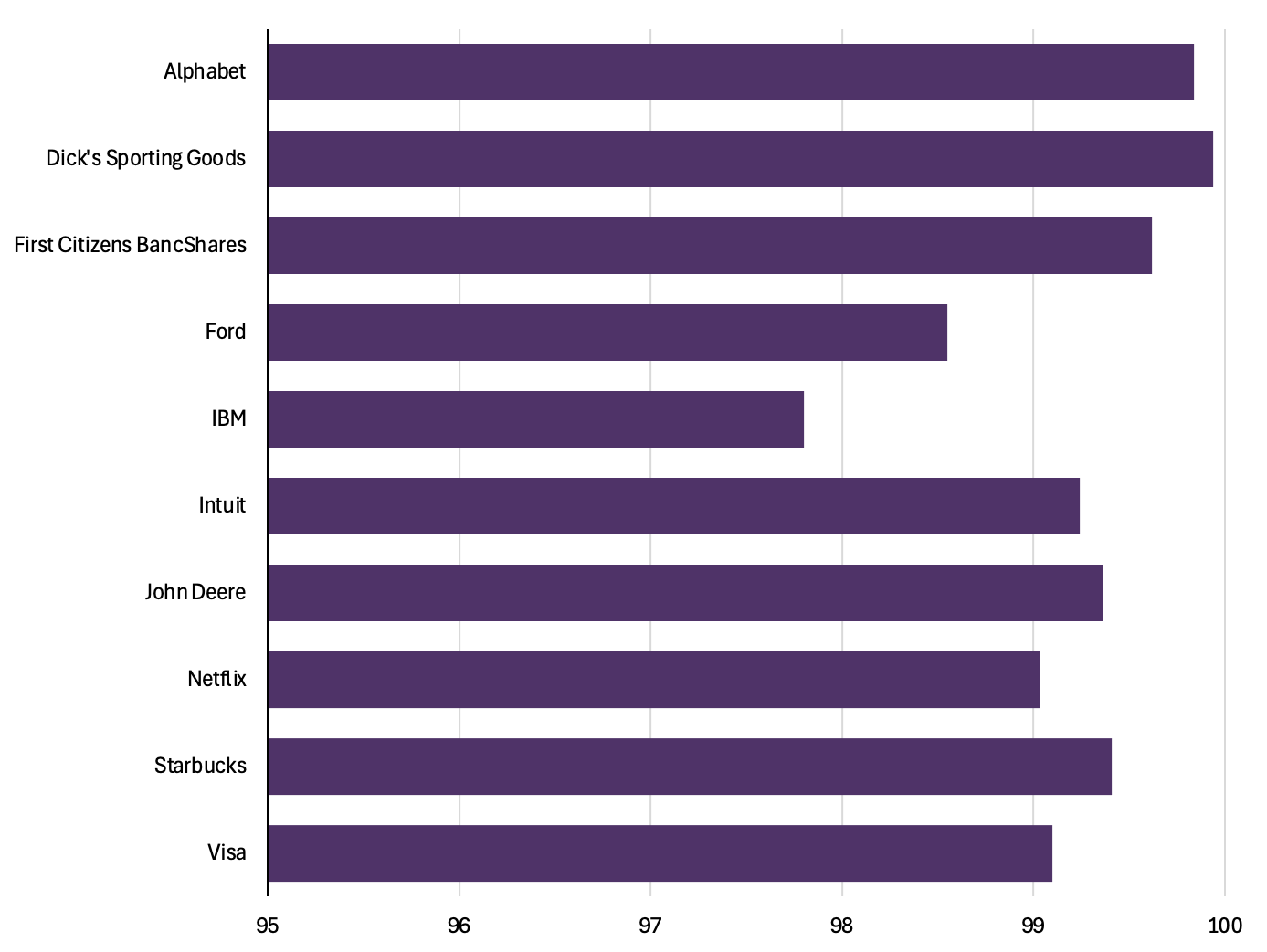 | Votes Against Anti-DEl Proposals (%)
X axis begins at 95% to show variation within the overwhelmingly high shareholder rejection range. |
|
|
|---|
|
| | | | | | FROM THE BOARDROOM Boards of directors consistently recommended that shareholders vote against the anti-DEI proposals. Many emphasized the role that inclusion, talent, innovation, and long-term value creation play in driving business performance and creating long-term shareholder value.
Ford Motor Company "Our commitment to attracting, retaining and developing talented employees with diverse backgrounds, experiences and perspectives strengthens our business and supports long-term shareholder value."
Visa Inc. "We believe that an inclusive culture inspires leadership, encourages innovative thinking, and supports the development and advancement of our employees."
Starbucks Corporation "Our continued success depends on our ability to attract and retain top talent. We believe our industry-leading total rewards program is essential to achieving this goal."
Netflix, Inc. "Many of these initiatives address compliance, risk management, stakeholder expectations, or company business objectives... that are important to our long-term success in shareholder value creation. | | | | | |
|
|---|
|
| | | | | | BRIDGE POVThe 2026 proxy season offers one of the clearest indicators yet of how investors view corporate inclusion. For the second consecutive year, shareholders overwhelmingly rejected anti-DEI proposals, despite an unprecedented wave of litigation, executive action, regulatory changes, and political pressure directed at corporate inclusion.
Proxy voting is one of the few places where every shareholder has an equal voice. Every vote carries a financial interest, and boards have a fiduciary obligation to act in the long-term interests of the company. Across nearly one hundred companies over the past two proxy seasons, investors consistently rejected efforts to dismantle corporate inclusion initiatives, while boards overwhelmingly recommended voting against those proposals.
Many of the proposals were advanced by conservative organizations seeking to reshape corporate governance around inclusion. Shareholders considered those proposals and overwhelmingly declined to support them. While these votes do not resolve the legal and regulatory questions organizations continue to navigate, they do provide an important signal about investor expectations. Corporate strategy should be grounded in long-term business performance, sound governance, and independent judgment, not political pressure.
ACTIONABLE STRATEGIES- Connect Inclusion to Business Performance: Continue to measure and communicate how inclusion contributes to innovation, talent, customer growth, risk management, and long-term value creation.
- Strengthen Board Oversight: Ensure inclusion remains part of regular board discussions and is integrated into human capital strategy, governance, and enterprise risk oversight.
- Stay Disciplined: Make decisions based on business performance, legal compliance, and long-term strategy—not external political pressure.
See also: Proxy Season 2025: A Defining Line on DEI (Issue 18); Intuit Shareholders Reject Anti-DEI Proposal, Extending Unbroken Streak of Investor Support (Issue 49); Visa Shareholders Reject Anti-DEI Proposal (Issue 50); Colgate-Palmolive Plans to Defend DEI Criteria for Board Selection (Issue 53) | | | | | |
|
|---|
|
| | | | | |
OVERVIEWOn June 18, 2026, shareholder advocacy organization As You Sow filed a Freedom of Information Act (FOIA) lawsuit against the U.S. Department of Labor seeking the release of federal contractors' 2021 and 2022 Type 2 (Consolidated) EEO-1 reports. The lawsuit alleges the Department failed to produce the requested records following a FOIA request submitted in April 2024 and subsequent administrative appeals. The requested reports contain consolidated workforce demographic data by race, ethnicity, sex, and job category.
As You Sow states that the data is used by investors, researchers, and policymakers to evaluate corporate hiring practices and assess the relationship between workforce diversity and financial performance. The organization also notes that previous research has identified statistically significant correlations between workforce diversity and a range of financial performance measures and argues that continued public access to EEO-1 data is important to shareholder engagement and corporate accountability.
The lawsuit follows earlier litigation that resulted in the disclosure of federal contractor Type 2 EEO-1 reports covering 2016 through 2020 after the Ninth Circuit concluded those reports were not exempt from disclosure under FOIA. As You Sow now seeks the same categories of records for the 2021 and 2022 reporting years.
LEGAL INTERPRETATIONThe lawsuit arises under the Freedom of Information Act (FOIA), 5 U.S.C. § 552, which permits members of the public to request existing records maintained by federal agencies, subject to specified statutory exemptions. After submitting a FOIA request in April 2024 for federal contractors' 2021 and 2022 Type 2 (Consolidated) EEO-1 reports, As You Sow alleges the Department of Labor failed to produce the requested records or provide a timetable for their release, prompting the organization to seek judicial review.
The complaint asks the U.S. District Court for the District of Columbia to declare the Department's withholding of the requested records unlawful, order their disclosure, and award costs and attorneys' fees. The lawsuit follows earlier litigation that resulted in the disclosure of federal contractors' 2016 through 2020 Type 2 EEO-1 reports after the Ninth Circuit concluded those records were not exempt from disclosure under FOIA.
The litigation also comes as the EEOC considers a proposal to rescind long-standing employer demographic reporting requirements, which, if finalized, would eliminate future EEO-1 workforce demographic reporting. That proposal is separate from this case, which concerns public access to previously collected records maintained by the Department of Labor.
BRIDGE POVWorkforce data has long been one of the foundations of effective governance. Whether organizations ultimately expand, reduce, or redesign their inclusion strategies, those decisions should be informed by evidence rather than assumption. As access to standardized workforce demographic data becomes more limited, leaders risk making decisions with less visibility into talent trends, representation, and organizational performance.
Limiting access to workforce data does not eliminate discrimination, disparate impact, or inequitable barriers to opportunity. It makes those patterns more difficult to identify, measure, investigate, and address. Regardless of how this litigation is resolved, private organizations carry an even greater responsibility to maintain the internal data, governance, and accountability systems needed to understand whether opportunity is being distributed fairly across hiring, promotion, compensation, and workplace experience. The absence of data is not the absence of risk.
ACTIONABLE STRATEGIES- Continue Measuring Workforce Outcomes: Maintain meaningful analysis across hiring, promotion, compensation, retention, and workforce experience regardless of changes to public reporting requirements.
- Strengthen Internal Governance: Ensure workforce data remains integrated into board oversight, enterprise risk management, and long-term talent strategy.
- Preserve Accountability: Continue using workforce data to identify barriers to opportunity, support consistent decision-making, and strengthen long-term organizational performance.
See also: EEOC Acting Commissioner Andrea Lucas Issued a Public "Message" Regarding the Use of EEO-1 Data (Issue 14); Pension Funds Sue AT&T Over Exclusion of Workforce Diversity Disclosure Proposal (Issue 53); EEOC Proposes Ending EEO-1 Reporting Requirements (Issue 65) | | | | | |
|
|---|
|
| | | | | |
A federal judge has allowed key discrimination claims against Workday to proceed, concluding that the complaint plausibly alleges the company may have acted as employers' agent by performing applicant screening functions traditionally handled by employers. The ruling suggests AI hiring vendors may not avoid liability under federal anti-discrimination laws solely because they are not the applicant's direct employer, particularly where they perform hiring functions on behalf of employers.
Judge Rita Lin also ruled that claims under California's Fair Employment and Housing Act (FEHA) may proceed where the alleged discriminatory conduct involves Workday's role in designing, operating, or administering hiring tools from California. Workday denies the allegations, and the case remains pending.
See also: Trump Issues Executive Order on the Use of DEI in AI (Issue 23); Federal Court Lets Age-Bias Claims Against Workday's AI Hiring Tools Proceed in Landmark Test of Algorithmic Screening (Issue 31); AI Governance, Civil Rights, and the Expanding Scope of Algorithmic Accountability (Issue 43) | | | | | |
|
|---|
|
| | | | | |
OVERVIEWOn June 18, 2026, the Department of Justice's Civil Rights Division referred Major League Baseball to the Equal Employment Opportunity Commission (EEOC) for investigation into whether the league violated Title VII by warning three San Francisco Giants pitchers who wrote a Bible verse on their caps during the team's June 12 Pride Night game. The DOJ referral centers on whether MLB failed to reasonably accommodate the players' religious expression under federal employment discrimination law.
The dispute arose after the players inscribed a Bible verse on their rainbow-logoed Pride Night caps. MLB issued what it described as a routine verbal warning, stating that additional writing on the caps violated the league's uniform policy. MLB has maintained that the warning was not disciplinary and had nothing to do with the religious content of the message, noting that it has issued similar warnings for other personal inscriptions on uniforms.
See also: EEOC Takes Action on Religious Discrimination While Transgender Protections Face Uncertainty (Issue 20); Federal Faith Initiative Expands as Workplace Policy Draws Legal Challenge (Issue 57); EEOC Replaces Strategic Enforcement Plan With New National Enforcement Plan (Issue 68) | | | | | |
|
|---|
|
| | | | | |
In a June 2026 memorandum, the Department of Justice's Office of Legal Counsel adopted a narrower interpretation of the Americans with Disabilities Act's integration mandate and the Supreme Court's decision in Olmstead v. L.C. The memorandum argues that Olmstead held only that states may not institutionalize individuals with disabilities without justification and does not impose a broader obligation to provide community-based services. The memorandum also acknowledges that this interpretation is "out of step with the common understanding" of Olmstead in the federal courts.
Disability rights advocates criticized the memorandum, arguing it departs from decades of federal disability rights enforcement and could lead states to reduce community-based support in favor of institutional care. The memorandum does not change the ADA, Section 504 of the Rehabilitation Act, or Supreme Court precedent, but it reflects a significant change in the Department of Justice's legal interpretation and enforcement position.
See also: CDC Ends Remote Work as Disability Accommodation, Raising Civil Rights Concerns (Issue 31); Texas-Led Coalition Challenges Federal Disability Integration Requirements Under Section 504 (Issue 50) | | | | | |
|
|---|
|
| | | | | |
On June 12, 2026, the Department of Veterans Affairs (VA) issued an internal memorandum directing the Veterans Health Administration to eliminate all DEI and DEIA programs and discontinue "gender-identity based" and "gender-ideology based" initiatives. The memorandum also redesignates LGBTQ+ Veteran Care Coordinators as Care Coordinators, eliminating the role's LGBTQ+-specific designation and directing that the positions support all veterans regardless of race, color, creed, religion, sex, or education. The directive states that the changes are intended to ensure compliance with Executive Orders 14151 and 14168.
LGBTQ+ advocates criticized the changes, arguing they will eliminate specialized support and case-management programs that have been vital for many LGBTQ+ veterans navigating the VA healthcare system. Shannon Minter, legal director of the National Center for LGBTQ Rights, stated that the directive will require the VA to discontinue programs that have helped LGBTQ+ veterans access care and benefits.
See also: Executive Orders 14151 and 14168 (Issue 1); Supreme Court Allows Trump Ban on Transgender Military Service to Go Into Effect (Issue 12); Supreme Court Upholds Tennessee Law Restricting Access to Healthcare for Transgender Minors (Issue 18); Gender-Affirming Care Ban Sparks Class Action Complaint from Employees Against Trump Administration (Issue 46); D.C. Circuit Blocks Discharge of Transgender Service Members (Issue 68) | | | | | |
|
|---|
|
COMMUNITY EVENTS | BRIDGE invites everyone to join for our monthly Community Calls which take place on the last Thursday of every month, gathering DEI marketing, and business leaders committed to driving systemic change within our organizations and the industry at large.
Our next call is Thursday, July 30th from 12-1p ET. | | |
|
|
|---|
ABOUT BRIDGE FORWARD | | | | | | | Led by BRIDGE, FORWARD is a weekly leadership briefing that distills the most consequential legal, political, and reputational developments shaping DEI and inclusive growth. Each issue provides legal interpretation, BRIDGE’s point of view, and actionable strategies to help leaders safeguard trust, anticipate risk and make credible value-based decisions in a volatile environment.
Who it’s for: CMOs, CCOs, Chief DEI Officers, GCs, Heads of Risk, CHROs, and senior leaders across DEI, marketing, brand, policy, and legal functions. FOR PAST ISSUES OF BRIDGE FORWARD WEEKLY GUIDANCE PLEASE VISIT HERE. *These BRIDGE FORWARD updates should not be construed as legal advice or counsel. They are for educational and instructive purposes only, to aid our understanding about how best to actively continue our mission in response to this moment. | | | | | |
|
|
|
|---|
 | |
|  | |
| |
|---|
|
|
|
|
|
|
|---|
|
| | 1276 Auto Park Way Suite D, PMB 183, Escondido, CA 92029 |
| This email was sent to {{ contact.EMAIL }} |
| You've received it because you've subscribed to our newsletter. |
| | |
|
|
|---|
|
|
|