| | WEEKLY ISSUE 73 | July 17, 2026 |
|
|
|
|---|
|
Mitigate Risk. Lead with Clarity. |
|
|---|
|
IN THIS ISSUE
ALSO INCLUDED |
|
|
|---|
|
PREVIOUSLY ISSUED EXECUTIVE ORDERS | For continued reference these are the EOs targeting DEI and LGBTQ+ protections that have been issued:
We will continue to monitor activities that relate to these EOs either directly or indirectly. |
|
|
|---|
|
| | | | | |
OVERVIEWOn July 10, 2026, The New York Times Company filed an answer and counterclaim against the Equal Employment Opportunity Commission in the U.S. District Court for the Southern District of New York in response to the EEOC's May 5, 2026 lawsuit alleging the newspaper violated Title VII by discriminating against a white male employee based on race and sex in filling a deputy real estate editor position.
The EEOC alleges that Bryant Rousseau, a longtime Times editor, was denied the promotion because of his race and sex and that the newspaper selected a multiracial woman who was less qualified. The Times denies the allegations, asserting that the successful candidate was selected based on qualifications, experience, and her vision for the role, and that their publicly stated workforce representation goals were aspirational rather than hiring quotas. The lawsuit was authorized by a 2-1 vote of the Commission, with Commissioner Kalpana Kotagal dissenting.
In its counterclaim, the Times alleges that the EEOC filed the lawsuit in retaliation for its reporting on the Trump administration and the Commission. The newspaper contends that the agency's actions violated its rights under the First and Fifth Amendments and the Administrative Procedure Act and asks the court to dismiss the EEOC's discrimination claims.
LEGAL INTERPRETATIONThe EEOC's underlying lawsuit is brought under Title VII of the Civil Rights Act of 1964, which prohibits employers from making employment decisions based on race or sex. Like any Title VII plaintiff, the EEOC must ultimately prove that race or sex was a motivating factor in the promotion decision. The Times denies those allegations, maintaining that the selected candidate was chosen based on legitimate, nondiscriminatory factors, including her qualifications, experience, and vision for the role.
The Times' counterclaims extend beyond defending the Title VII allegations by challenging the EEOC's conduct in bringing the lawsuit. Specifically, the newspaper alleges that the Commission retaliated against The Times for engaging in protected newsgathering, reporting, editorial expression, and speech in violation of the First Amendment. It also alleges that the Commission's actions violated the Fifth Amendment's guarantee of due process and the Administrative Procedure Act, which governs how federal agencies exercise their statutory authority. Among its claims, The Times also argues that it lacked fair notice that its public statements describing aspirational workforce representation goals would be interpreted by the EEOC as unlawful proxies for quotas, which the EEOC claimed in a National Enforcement Plan it published after filing the lawsuit against The Times.
These constitutional and administrative law claims are separate from the underlying Title VII discrimination claim and present legal questions regarding whether a federal agency may use its enforcement authority in a manner that unlawfully retaliates against protected speech or otherwise exceeds constitutional and statutory limits.
BRIDGE POVThe New York Times' counterclaim shifts this litigation beyond a traditional employment discrimination case by challenging the EEOC's conduct in bringing the lawsuit itself. Rather than disputing only the underlying Title VII allegations, the Times alleges that the Commission's enforcement action violated constitutional protections and was influenced by factors unrelated to the merits of the employment decision.
The case also raises broader questions about the role of the First Amendment in protecting the independence of the press. A free and independent press plays a critical role in holding public institutions accountable, and constitutional protections for freedom of speech and of the press are foundational to that function. While the court will ultimately determine the merits of the Times' claims, the litigation underscores the importance of preserving public confidence in both independent journalism and the impartial enforcement of federal civil rights laws.
ACTIONABLE STRATEGIES- Document Employment Decisions: Ensure hiring and promotion decisions are supported by objective, job-related criteria and consistent documentation.
- Review Public Commitments: Confirm that public statements, workforce goals, and internal communications accurately reflect how employment decisions are made.
- Protect Institutional Integrity: Maintain governance practices that reinforce lawful decision-making, organizational independence, and confidence in the integrity of your employment practices.
See also: EEOC Files Suit Against the New York Times (Issue 64) | | | | | |
|
|---|
|
| | | | | |
OVERVIEWOn June 25, 2026, the U.S. Supreme Court granted the administration's request to stay a lower court order that had temporarily blocked the Department of Homeland Security (DHS) from terminating Temporary Protected Status (TPS) for hundreds of thousands of Haitian nationals. The decision allows DHS to move forward with ending TPS protections while litigation challenging the termination continues.
Following the Court's ruling, DHS and U.S. Citizenship and Immigration Services (USCIS) issued updated guidance regarding employment authorization for TPS beneficiaries from Haiti, Ethiopia, Somalia, Myanmar (Burma), Syria, Yemen, and South Sudan. The agencies temporarily extended work authorization for affected individuals by one to two weeks, with employment authorization expiring today for six countries and July 24, 2026, for Haiti.
The changes affect more than 330,000 Haitian TPS beneficiaries and approximately 26,000 individuals from the six other affected countries. As work authorization expires, employers remain responsible for complying with federal Form I-9 employment verification requirements and may not continue employing individuals who are no longer authorized to work under federal law. The changing deadlines have created compliance and workforce planning challenges for employers across multiple industries.
LEGAL INTERPRETATIONTemporary Protected Status (TPS), established under the Immigration Act of 1990, authorizes the Secretary of Homeland Security to designate countries experiencing armed conflict, environmental disasters, or other extraordinary and temporary conditions that prevent their nationals from returning safely. Individuals granted TPS may remain in the United States temporarily and receive employment authorization for the duration of the designation.
On June 25, 2026, in Mullin v. Doe, the U.S. Supreme Court held that the Trump administration could proceed with terminating TPS protections for Haitian and Syrian nationals while litigation continues. The Court concluded that the TPS statute does not permit judicial review of most DHS decisions regarding TPS designations and found that the plaintiffs' constitutional claims were unlikely to succeed.
The decision does not alter existing obligations under federal employment verification laws. Employers must continue to comply with Form I-9 requirements and may not knowingly continue employing individuals whose work authorization has expired. As DHS and U.S. Citizenship and Immigration Services continue to update employment authorization guidance, employers should ensure reverification practices remain consistent with current federal requirements.
BRIDGE POVThis case illustrates how rapidly changing federal immigration policies can create immediate workforce challenges for employers and employees. Regardless of the outcome of the underlying litigation, organizations remain responsible for complying with changing employment authorization requirements while maintaining operational continuity.
The ruling also serves as a reminder that workforce decisions affect people as well as operations. Many individuals impacted by these changes have lived and worked in the United States for years and may face significant uncertainty as their employment authorization expires. While employers must comply with federal law, legal compliance and human compassion are not mutually exclusive. Organizations have an opportunity to lead with humanity by understanding the personal impact on affected employees, communicating with empathy, and identifying appropriate ways to support individuals through periods of transition and uncertainty.
ACTIONABLE STRATEGIES- Assess Workforce Impact: Identify employees who may be affected and develop plans to address potential workforce disruptions.
- Lead with Humanity: Communicate with affected employees early, understand the personal implications of these changes, and identify appropriate ways to support them through the transition.
- Maintain Compliance: Ensure Form I-9 reverification processes remain current and aligned with DHS and USCIS guidance.
See also: Minnesota CEOs Break Silence on ICE Surge and Enforcement Violence (Issue 49); Trump's H-1B Fee Signals New Barriers to Global Talent and Corporate Innovation (Issue 32); Federal Court Voids $100,000 H-1B Visa Fee (Issue 68) | | | | | |
|
|---|
|
| | | | | |
As the 2026 proxy season concludes, a review of verified shareholder votes shows that investors continued to overwhelmingly reject proposals seeking to curtail corporate diversity, equity and inclusion initiatives and related workplace policies. While Harvard Law School's Shareholder Rights Program identified 45 anti-DEI proposals submitted during the 2026 proxy season, not all advanced to a shareholder vote. Several proposals were withdrawn following agreements between proponents and companies, while others were excluded from proxy ballots or otherwise did not proceed to a vote.
Among the proposals that reached a shareholder vote, most received less than 2% shareholder support, with many receiving less than 1%. The proposals addressed a broad range of workplace issues, including DEI governance, charitable giving, employee resource groups, board diversity, executive compensation, LGBTQ+ employee benefits, federal contracting, and religious accommodation. Despite increased public debate and regulatory scrutiny surrounding DEI, shareholders largely declined to support efforts to materially alter corporate workplace inclusion policies through the proxy process. | | | | | |
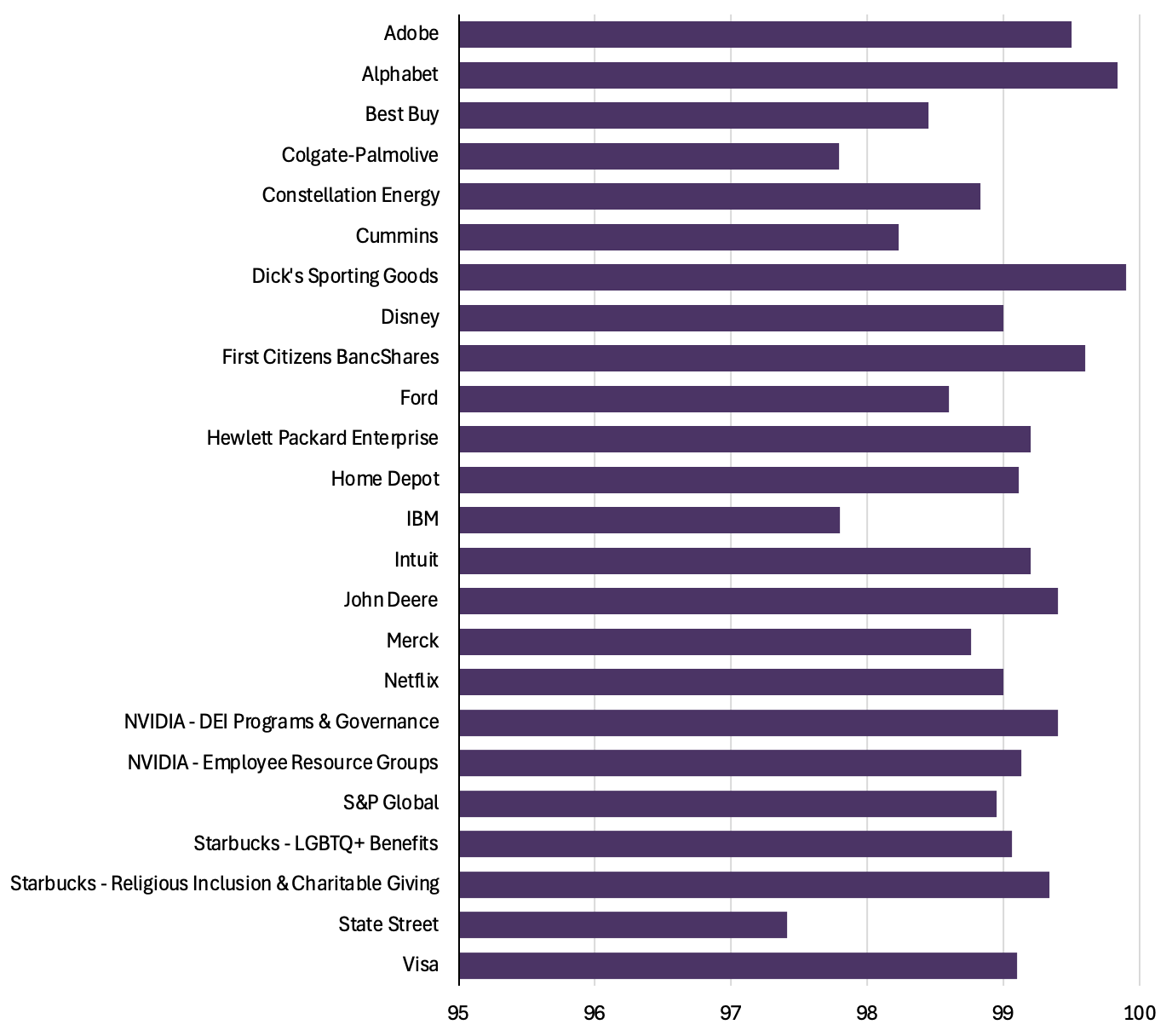 |
Votes Against Anti-DEl Proposals (%)
X axis begins at 95% to show variation within the overwhelmingly high shareholder rejection range. |
|
|---|
|
| | | | | |
On July 7, 2026, the U.S. Court of Appeals for the Eleventh Circuit, in a 2-1 decision, affirmed a lower court injunction blocking enforcement of Florida's "Stop W.O.K.E. Act" in the state's public colleges and universities. The law restricted the teaching of certain concepts related to race, sex, and unconscious bias in college classrooms. The court held that the law violated the First Amendment by restricting professors' speech based on viewpoint and rejected the state's argument that classroom instruction constitutes unprotected government speech. The decision marks the first federal appellate ruling striking down a state higher education classroom censorship law on First Amendment grounds.
See also: Federal Judge Strikes Trump-Era Anti-DEI Directives (Issue 26); Mississippi Federal Court Blocks DEI Ban; Alabama Court Allows It to Stand (Issue 26); Students and Professors Push Back — Appeal Seeks to Block Alabama's Ban on Campus DEI Programs (Issue 43); First Amendment Likely Bars DEI Grant Terminations (Issue 66) | | | | | |
|
|---|
|
FEDERAL FUNDING & OVERSIGHT |
|
|
|---|
|
| | | | | |
On July 9, 2026, U.S. District Judge William Orrick granted a preliminary injunction blocking the Trump administration from imposing anti-DEI and immigration-related conditions on certain federal grants awarded to 11 cities and counties in California and Oregon. The challenged conditions required applicants to certify that they do not support programs advancing DEI and to cooperate with federal immigration enforcement. The court found the plaintiffs were likely to succeed on claims that the administration exceeded its constitutional and statutory authority, concluding that the challenged conditions were inconsistent with Congress's funding directives. The injunction remains in effect while the litigation proceeds.
See also: Federal Judge Questions Undefined "Illegal DEI" Restrictions in Emergency-Funding Case (Issue 39); Seventh Circuit Panel Challenges Trump Administration to Define Illegal DEI (Issue 50); First Amendment Likely Bars DEI Grant Terminations (Issue 66); OMB Proposes Rule Barring Federal Grants for DEI Activities (Issue 67); D.C. Judge Blocks USDA Grant Terminations Over DEI Policies (Issue 71) | | | | | |
|
|---|
|
COMMUNITY EVENTS | BRIDGE invites everyone to join for our monthly Community Calls which take place on the last Thursday of every month, gathering DEI marketing, and business leaders committed to driving systemic change within our organizations and the industry at large.
July is Disability Pride Month, a time to recognize the contributions, perspectives and leadership of the disability community. This year's theme, "The World Works Better With Us," reminds us that disability inclusion isn't just about accessibility. It's about designing organizations, experiences and products that work better for everyone.
Join us for our July Community Call featuring Emily Goodson, wellbeing speaker and author of Dating Disability, as we explore why disability inclusion is becoming an increasingly important driver of innovation, customer relevance and organizational performance.
Our next call is Thursday, July 30th from 12-1p ET. | | |
|
|
|---|
ABOUT BRIDGE FORWARD | | | | | | | Led by BRIDGE, FORWARD is a weekly leadership briefing that distills the most consequential legal, political, and reputational developments shaping DEI and inclusive growth. Each issue provides legal interpretation, BRIDGE’s point of view, and actionable strategies to help leaders safeguard trust, anticipate risk and make credible value-based decisions in a volatile environment.
Who it’s for: CMOs, CCOs, Chief DEI Officers, GCs, Heads of Risk, CHROs, and senior leaders across DEI, marketing, brand, policy, and legal functions. FOR PAST ISSUES OF BRIDGE FORWARD WEEKLY GUIDANCE PLEASE VISIT HERE. *These BRIDGE FORWARD updates should not be construed as legal advice or counsel. They are for educational and instructive purposes only, to aid our understanding about how best to actively continue our mission in response to this moment. | | | | | |
|
|
|
|---|
 | |
|  | |
| |
|---|
|
|
|
|
|
|
|---|
|
| | 1276 Auto Park Way Suite D, PMB 183, Escondido, CA 92029 |
| This email was sent to {{ contact.EMAIL }} |
| You've received it because you've subscribed to our newsletter. |
| | |
|
|
|---|
|
|
|